
Function words in Spanish
Pronouns, articles, demonstratives, possessives: the small words of Spanish grammar you cannot build a sentence without.
Here are 100 Spanish words on “Function words”, translated into English and sorted from easiest to hardest.
Tap the speaker next to a word to hear it.
Level 1: easy 44 words
| Spanish | English |
|---|---|
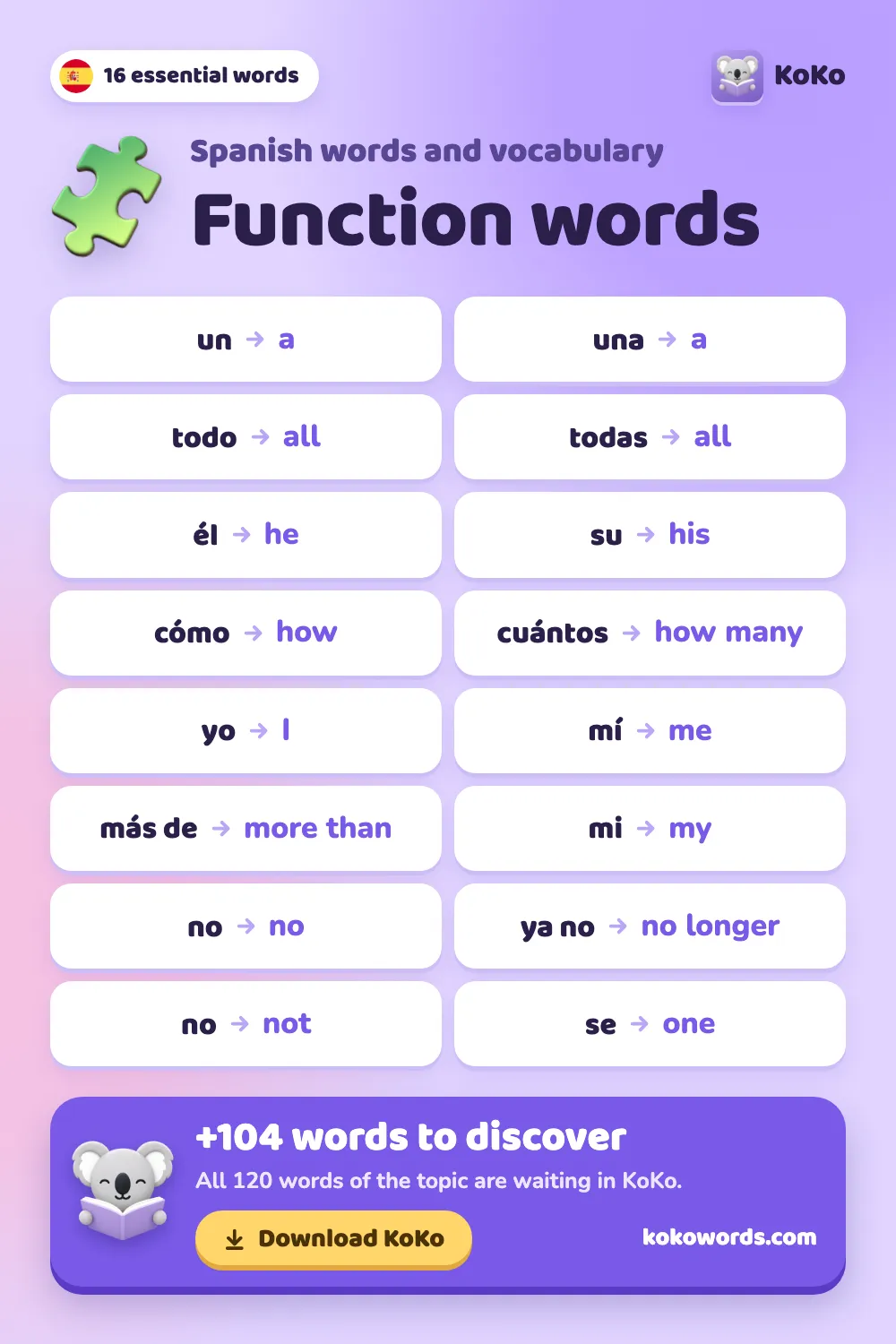
| un | aIndefinite article, masculine singular |
| una | aIndefinite article, feminine singular |
| todo | allDeterminer or pronoun, the whole of a set |
| todas | allDeterminer, feminine plural |
| él | heSubject pronoun, masculine singular |
| su | hisSingular possessor, belonging to him or her |
| cómo | how |
| cuántos | how manyFollowed by a noun, to ask about a number |
| yo | ISubject pronoun, first person singular |
| mí | meStressed form, after a preposition or on its own |
| más de | more than |
| mi | myPossessive determiner, before the noun |
| no | noNegative answer |
| ya no | no longer |
| no | notNegating the verb |
| se | one |
| ella | sheSubject pronoun, feminine singular |
| de la | somePartitive article, feminine singular |
| del | somePartitive article, masculine singular |
| algo | somethingIndefinite pronoun, an unspecified thing |
| eso | thatDemonstrative pronoun, refers to something far away or already mentioned |
| aquella | that oneDemonstrative pronoun, feminine singular |
| aquel | that oneDemonstrative pronoun, masculine singular |
| la | theDefinite article, feminine singular |
| los | theDefinite article, plural |
| su | theirPlural possessor, belonging to them |
| ellos | themStressed pronoun after a preposition |
| hay | there isExistence |
| estos | theseDemonstrative determiner, plural |
| ellos | theySubject pronoun |
| este | this |
| esta | thisDemonstrative determiner, feminine singular |
| este | this |
| esto | this oneDemonstrative pronoun, refers to something close |
| nosotros | weSubject pronoun, first person plural |
| qué | whatQuestion word, subject |
| qué | whatBefore a verb |
| qué | whatOn its own or after a preposition |
| cuándo | when |
| dónde | where |
| sí | yesYes, contradicting a negative statement |
| te | youObject pronoun, informal address |
| tú | youSubject, informal address |
| usted | youSubject, formal or plural address |
Level 2: medium 38 words
| Spanish | English |
|---|---|
| un poco de | a little |
| toda | allDeterminer, feminine singular |
| cada | eachDeterminer, before the noun |
| cada uno | each onePronoun, masculine singular |
| bastante | enough of |
| todo el mundo | everybodyPeople in general, everyone together |
| le | himObject pronoun, to him or to her |
| él mismo | himselfReflexive pronoun, masculine singular |
| suyo | his ownPossessive pronoun, used on its own |
| cuánto | how muchUsed on its own, to ask about a quantity or a price |
| la mayoría | most |
| yo mismo | myself |
| nunca | never |
| nadie | no oneFormal or legal register |
| nadie | nobodyEveryday use |
| ninguno | nonePronoun, used on its own |
| ningún | not anyDeterminer, in a negative sentence |
| nada | nothingPronoun used on its own |
| nada | nothingNegation used with the verb |
| de ello | of it |
| uno mismo | oneselfReflexive pronoun, simple form |
| otro | other |
| nuestro | ourPossessive determiner, belonging to us |
| mismo | same |
| desde cuándo | since when |
| unos | someIndefinite article, plural, before a noun |
| alguien | someoneIndefinite pronoun, an unspecified person |
| tal | such |
| ahí | thereAdverbial pronoun of place, replaces a complement |
| aquellos | thoseDemonstrative pronoun, masculine plural |
| aquellas | thoseDemonstrative pronoun, feminine plural |
| demasiado | too much |
| cuál | whichInterrogative determiner, before the noun |
| por qué | why |
| por qué no | why not |
| ti | youStressed form, after a preposition |
| tu | yourInformal address |
| su | yourFormal or plural address; possessor addressed formally or in the plural |
Level 3: hard 18 words
| Spanish | English |
|---|---|
| de cualquier manera | any which way |
| cualquiera | anyone |
| cualquier cosa | anything |
| en cualquier momento | anytime |
| en cualquier lugar | anywhere |
| cada una | each onePronoun, feminine singular |
| uno a otro | each otherMutual action between two people |
| apenas | hardly |
| ella misma | herselfReflexive pronoun, feminine singular |
| hasta dónde | how far |
| unos a otros | one anotherMutual action among several people |
| sí mismo | oneselfEmphatic form, stresses the subject |
| nosotros mismos | ourselves |
| ellos mismos | themselvesReflexive pronoun, masculine plural |
| quienquiera | whoever |
| cuyo | whose |
| tuyo | yoursPossessive pronoun, used on its own |
| tú mismo | yourself |
Mini quiz
5 words from this page, picked at random. Find their translation.
Frequently asked questions
- How many words are in this list?
- This page gives 100 Spanish words on “Function words”. The full topic holds 120 in the KoKo app: 52 at the easy level, 46 at the medium level and 22 at the hard level.
- Which words should I start with?
- With level 1: these are the easiest words of the topic. Move on to level 2 once they come to you without thinking, then to level 3.
- How can I remember this Spanish vocabulary?
- By seeing each word again at longer and longer intervals, just before you forget it: that is spaced repetition. The KoKo app does it for you and tells you each day which words to review.
- Can I print this list or save it as a PDF?
- Yes. The “Print the list” button at the top of the page opens your device’s print dialog: choose to save as PDF to keep the 100 words and their translation, with nothing else around them.
- How do I pronounce these words?
- Tap the speaker next to a word: your device reads it aloud, if it has a voice for this language. In the KoKo app, every word is read aloud.
These lists come from KoKo, the app to learn Spanish vocabulary on iPhone.
In the same block: Grammar
Lists by situation
- 100 intermediate Spanish words
- 100 advanced Spanish words
- 20 Spanish words for asking questions
- Your first 100 Spanish words
This topic in other languages
- 🇨🇳Simplified Chinese
- 🇹🇼Traditional Chinese
- 🇮🇳Hindi
- 🇸🇦Arabic
- 🇫🇷French
- 🇵🇹Portuguese
- 🇷🇺Russian
- 🇮🇩Indonesian
- 🇩🇪German
- 🇯🇵Japanese
- 🇹🇷Turkish
- 🇻🇳Vietnamese
- 🇰🇷Korean
- 🇲🇾Malay
- 🇮🇹Italian
- 🇹🇭Thai
- 🇵🇱Polish
- 🇺🇦Ukrainian
- 🇳🇱Dutch
- 🇷🇴Romanian
- 🇬🇷Greek
- 🇭🇺Hungarian
- 🇸🇪Swedish
- 🇨🇿Czech
- 🇮🇱Hebrew
- 🇸🇰Slovak
- 🇩🇰Danish
- 🇫🇮Finnish
- 🇳🇴Norwegian