
Function words in German
Pronouns, articles, demonstratives, possessives: the small words of German grammar you cannot build a sentence without.
Here are 100 German words on “Function words”, translated into English and sorted from easiest to hardest.
Tap the speaker next to a word to hear it.
Level 1: easy 44 words
| German | English |
|---|---|
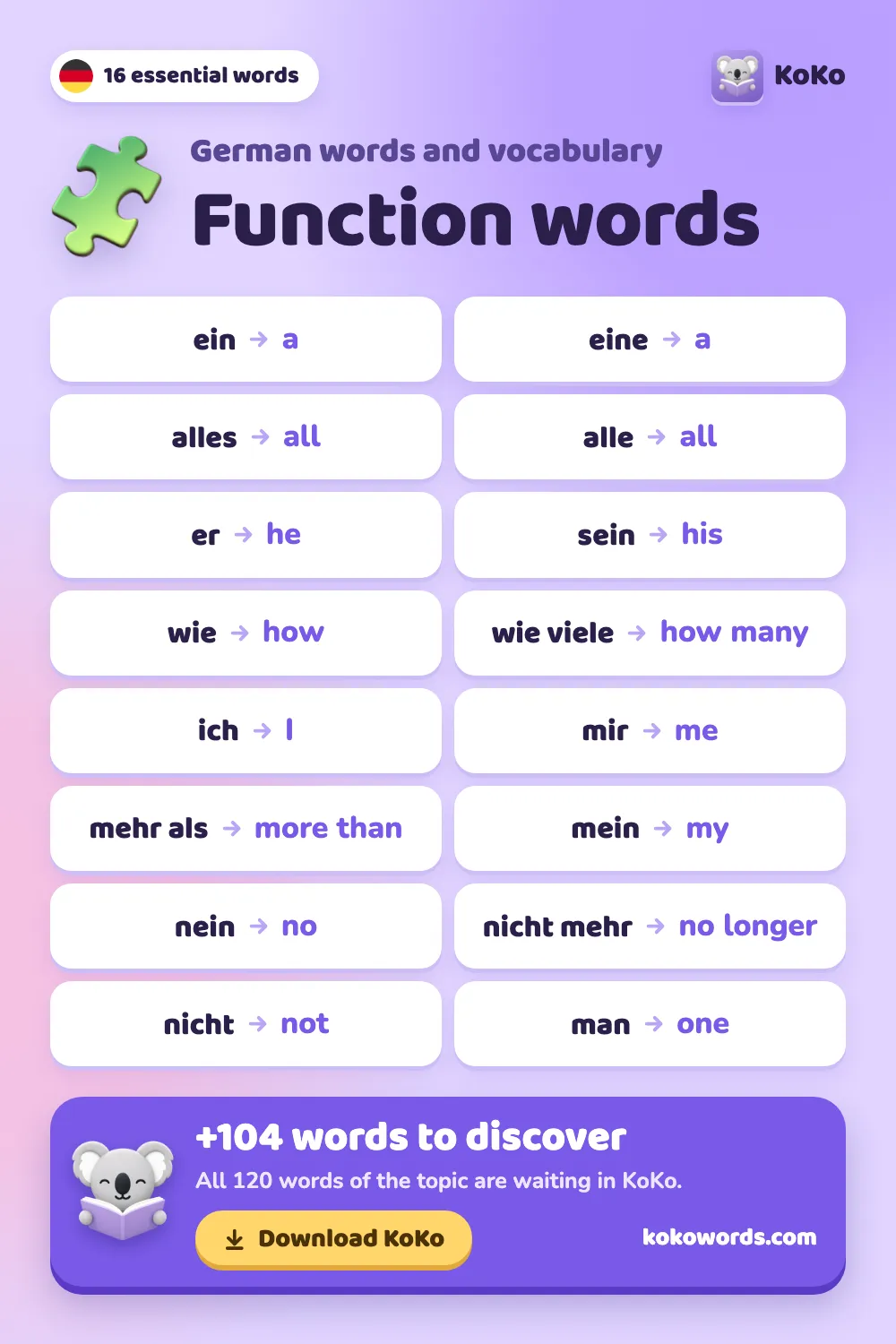
| ein | aIndefinite article, masculine singular |
| eine | aIndefinite article, feminine singular |
| alles | allDeterminer or pronoun, the whole of a set |
| alle | allDeterminer, feminine plural |
| Wir alle machen Fehler.We all make mistakes. | |
| er | heSubject pronoun, masculine singular |
| Wo ist er?Where is he? | |
| sein | hisSingular possessor, belonging to him or her |
| Sein Sohn ist acht Jahre alt.His son is eight years old. | |
| wie | how |
| Wie alt bist du?How old are you? | |
| wie viele | how manyFollowed by a noun, to ask about a number |
| Wie viele Kinder hast du?How many children do you have? | |
| ich | ISubject pronoun, first person singular |
| Ich heiße Tom.I'm called Tom. | |
| mir | meStressed form, after a preposition or on its own |
| Das ist mir egal.That doesn't matter to me. | |
| mehr als | more than |
| Vier Augen sehen mehr als zwei.Four eyes see more than two. | |
| mein | myPossessive determiner, before the noun |
| Ich will nicht, daß mein Land Mitglied der Europäischen Union wird.I don't want my country to become a member of the European Union. | |
| nein | noNegative answer |
| nicht mehr | no longer |
| Ich liebe dich nicht mehr.I no longer love you. | |
| nicht | notNegating the verb |
| Das stimmt nicht.It's not true. | |
| man | one |
| Wie sagt man das auf Italienisch?How do you say that in Italian? | |
| sie | sheSubject pronoun, feminine singular |
| Sie ist reich.She's rich. | |
| etwas | somePartitive article, feminine singular |
| etwas | somePartitive article, masculine singular |
| etwas | somethingIndefinite pronoun, an unspecified thing |
| Ich höre etwas.I hear something. | |
| das | thatDemonstrative pronoun, refers to something far away or already mentioned |
| Was bedeutet das?What does that mean? | |
| diejenige | that oneDemonstrative pronoun, feminine singular |
| Denken alle, ich wäre diejenige, die das Geld gestohlen hat?Does everyone think it was me who stole the money? | |
| derjenige | that oneDemonstrative pronoun, masculine singular |
| Derjenige, der das gemacht hat, muss es reparieren.Whoever did that has to mend it. | |
| die | theDefinite article, feminine singular |
| Die Rechnung, bitte.Could you bring us the bill, please? | |
| die | theDefinite article, plural |
| Wo sind die Äpfel?Where are the apples? | |
| ihr | theirPlural possessor, belonging to them |
| ihnen | themStressed pronoun after a preposition |
| Ich sagte ihnen, sie sollen mir ein neues Ticket schicken.I told them to send me another ticket. | |
| es gibt | there isExistence |
| Es gibt viele Wörter, die ich nicht verstehe.There are many words that I don't understand. | |
| diese | theseDemonstrative determiner, plural |
| Diese Häuser sind 500 Jahre alt.Those houses are 500 years old. | |
| sie | theySubject pronoun |
| dieser | this |
| Welche Farbe hat dieser Fisch?What colour is this fish? | |
| diese | thisDemonstrative determiner, feminine singular |
| Diese Rose ist schön.This rose is beautiful. | |
| dieser | this |
| Wer ist dieser Mann?Who is this man? | |
| dies | this oneDemonstrative pronoun, refers to something close |
| Dies ist ein Baum.This is a tree. | |
| wir | weSubject pronoun, first person plural |
| Wo sind wir?Where are we? | |
| was | whatQuestion word, subject |
| Was ist geschehen?What happened? | |
| was | whatBefore a verb |
| Was bedeutet das?What does it mean? | |
| was | whatOn its own or after a preposition |
| Ich weiß einfach nicht, was ich sagen soll.I just don't know what to say. | |
| wann | when |
| wo | where |
| Wo ist er?Where is he? | |
| doch | yesYes, contradicting a negative statement |
| dich | youObject pronoun, informal address |
| Ich kenne dich nicht.I don't know you. | |
| du | youSubject, informal address |
| Bist du zu Hause?Are you home? | |
| Sie | youSubject, formal or plural address |
Level 2: medium 38 words
| German | English |
|---|---|
| ein wenig | a little |
| Ich bin ein wenig müde.I'm a little tired. | |
| ganze | allDeterminer, feminine singular |
| Dieser Berg ist das ganze Jahr mit Schnee bedeckt.This mountain is covered in snow all year round. | |
| jeder | eachDeterminer, before the noun |
| Jeder kennt jeden.Everyone knows each other. | |
| jeder | each onePronoun, masculine singular |
| Jeder will Geld.Everyone wants money. | |
| genug | enough of |
| Im Sitzungszimmer sind nicht genug Stühle.There are not enough chairs in the meeting room. | |
| jedermann | everybodyPeople in general, everyone together |
| Das Glück winkt nicht jedermann.Not everyone is lucky. | |
| ihm | himObject pronoun, to him or to her |
| Gib es ihm.Give it to him. | |
| er selbst | himselfReflexive pronoun, masculine singular |
| Er selbst hat sich geweigert, mit ihr zu sprechen.He himself refused to talk to her. | |
| seiner | his ownPossessive pronoun, used on its own |
| wie viel | how muchUsed on its own, to ask about a quantity or a price |
| Wie viel Geld hast du?How much money do you have? | |
| die meisten | most |
| Die meisten denken so.Most people think so. | |
| ich selbst | myself |
| Das tue ich selbst.I'll do that by myself. | |
| nie | never |
| niemand | no oneFormal or legal register |
| Es war niemand da.No one was there. | |
| niemand | nobodyEveryday use |
| Es war niemand da.Nobody was there. | |
| keiner | nonePronoun, used on its own |
| kein | not anyDeterminer, in a negative sentence |
| nichts | nothingPronoun used on its own |
| Er sagte nichts.He said nothing. | |
| nichts | nothingNegation used with the verb |
| davon | of it |
| Nichts davon ist wahr.None of it is true. | |
| sich | oneselfReflexive pronoun, simple form |
| andere | other |
| Eine andere Welt ist möglich.Another world is possible. | |
| unser | ourPossessive determiner, belonging to us |
| Das ist unser Haus.That's our house. | |
| gleich | same |
| seit wann | since when |
| Seit wann lernst du Esperanto?How long ago did you start learning Esperanto? | |
| einige | someIndefinite article, plural, before a noun |
| Es gibt da einige Dinge, die ich nicht verstehe.There are some things that I don't understand. | |
| jemand | someoneIndefinite pronoun, an unspecified person |
| Ist jemand zu Hause?Is anyone in? | |
| solch | such |
| Ein solch lächerlicher Aberglaube besteht nicht länger.Such a ridiculous superstition no longer exists. | |
| dorthin | thereAdverbial pronoun of place, replaces a complement |
| Ich wollte dorthin gehen.I wanted to go there. | |
| diejenigen | thoseDemonstrative pronoun, masculine plural |
| Diejenigen, die auf dem Fußboden schlafen, fallen nie aus ihren Betten. | |
| diejenigen | thoseDemonstrative pronoun, feminine plural |
| zu viel | too much |
| Ich habe zu viel zu tun.I've got too much to do. | |
| welcher | whichInterrogative determiner, before the noun |
| Welcher Tag ist heute?What day is it? | |
| warum | why |
| Warum ist der Himmel blau?Why is the sky blue? | |
| warum nicht | why not |
| Warum nicht morgen?Why not tomorrow? | |
| dir | youStressed form, after a preposition |
| Tom will mit dir sprechen.Tom wants to talk to you. | |
| dein | yourInformal address |
| Wo ist dein Bruder?Where's your brother? | |
| Ihr | yourFormal or plural address; possessor addressed formally or in the plural |
| Ihr Auto gefällt mir.I like your car. | |
Level 3: hard 18 words
| German | English |
|---|---|
| irgendwie | any which way |
| irgendwer | anyone |
| Fehlt heute irgendwer?Is anyone absent today? | |
| irgendetwas | anything |
| Er wagte nicht, irgendetwas zu sagen.He didn't dare say anything. | |
| irgendwann | anytime |
| Komm irgendwann mal vorbei und sieh uns beim Musikmachen zu!Come watch us play music sometime. | |
| irgendwo | anywhere |
| Gehst du irgendwo hin?Are you going anywhere? | |
| jede | each onePronoun, feminine singular |
| einander | each otherMutual action between two people |
| Sie lieben einander.They love each other. | |
| kaum | hardly |
| Er kann kaum sprechen.He can hardly speak. | |
| sie selbst | herselfReflexive pronoun, feminine singular |
| Diese Kuchen hat sie selbst gebacken.These are cakes that she baked herself. | |
| wie weit | how far |
| Wie weit ist es von hier zum Museum?How far is it from here to the museum? | |
| einander | one anotherMutual action among several people |
| Es ist unsere Pflicht, einander zu helfen.It is our duty to help one another. | |
| sich selbst | oneselfEmphatic form, stresses the subject |
| Jeder ist sich selbst der Nächste.It's every man for himself. | |
| wir selbst | ourselves |
| Diese Erfahrung haben wir selbst gemacht.We experienced that ourselves. | |
| sie selbst | themselvesReflexive pronoun, masculine plural |
| Nur sie selbst verstehen, was sie sagen.Only they themselves understand what they say. | |
| wer auch immer | whoever |
| Wer auch immer anruft, sag ihm, ich bin nicht da.Whoever telephones, tell him I'm out. | |
| dessen | whose |
| Ich habe einen Freund, dessen Vater Lehrer ist.I have a friend whose father is a teacher. | |
| deiner | yoursPossessive pronoun, used on its own |
| Meine Meinung unterscheidet sich von deiner.My opinion differs from yours. | |
| du selbst | yourself |
| Sei du selbst!Be yourself! | |
Example sentences: Tatoeba (CC BY 2.0 FR)
Updated · Spotted a mistake? · Sources
Mini quiz
5 words from this page, picked at random. Find their translation.
Frequently asked questions
- How do you say “one” in German?
- “One” in German is man.
- How do you say “where” in German?
- “Where” in German is wo.
- How do you say “when” in German?
- “When” in German is wann.
- How many words are in this list?
- This page gives 100 German words on “Function words”. The full topic holds 120 in the KoKo app: 52 at the easy level, 46 at the medium level and 22 at the hard level.
- How can I remember this German vocabulary?
- By seeing each word again at longer and longer intervals, just before you forget it: that is spaced repetition. The KoKo app does it for you and tells you each day which words to review.
- Can I print this list or save it as a PDF?
- Yes. The “Print the list” button at the top of the page opens your device’s print dialog: choose to save as PDF to keep the 100 words and their translation, with nothing else around them.
- How do I pronounce these words?
- Tap the speaker next to a word: your device reads it aloud, if it has a voice for this language. In the KoKo app, every word is read aloud.
These lists come from KoKo, the app to learn German vocabulary on iPhone and Android.
Keep going
- Greetings and polite phrases in German
- Adjectives in German
- Time, days and months in German
- Shopping in German
- Colours and shapes in German
- All 38 German topics
 Simplified Chinese
 Traditional Chinese
 Hindi
 French
 Russian
 Indonesian
 Japanese
 Vietnamese
 Korean
 Italian
 Thai
 Polish
 Romanian
 Hebrew
 Danish
 Norwegian