
Function words in Polish
Pronouns, articles, demonstratives, possessives: the small words of Polish grammar you cannot build a sentence without.
Here are 100 Polish words on “Function words”, translated into English and sorted from easiest to hardest.
Tap the speaker next to a word to hear it.
Level 1: easy 44 words
| Polish | English |
|---|---|
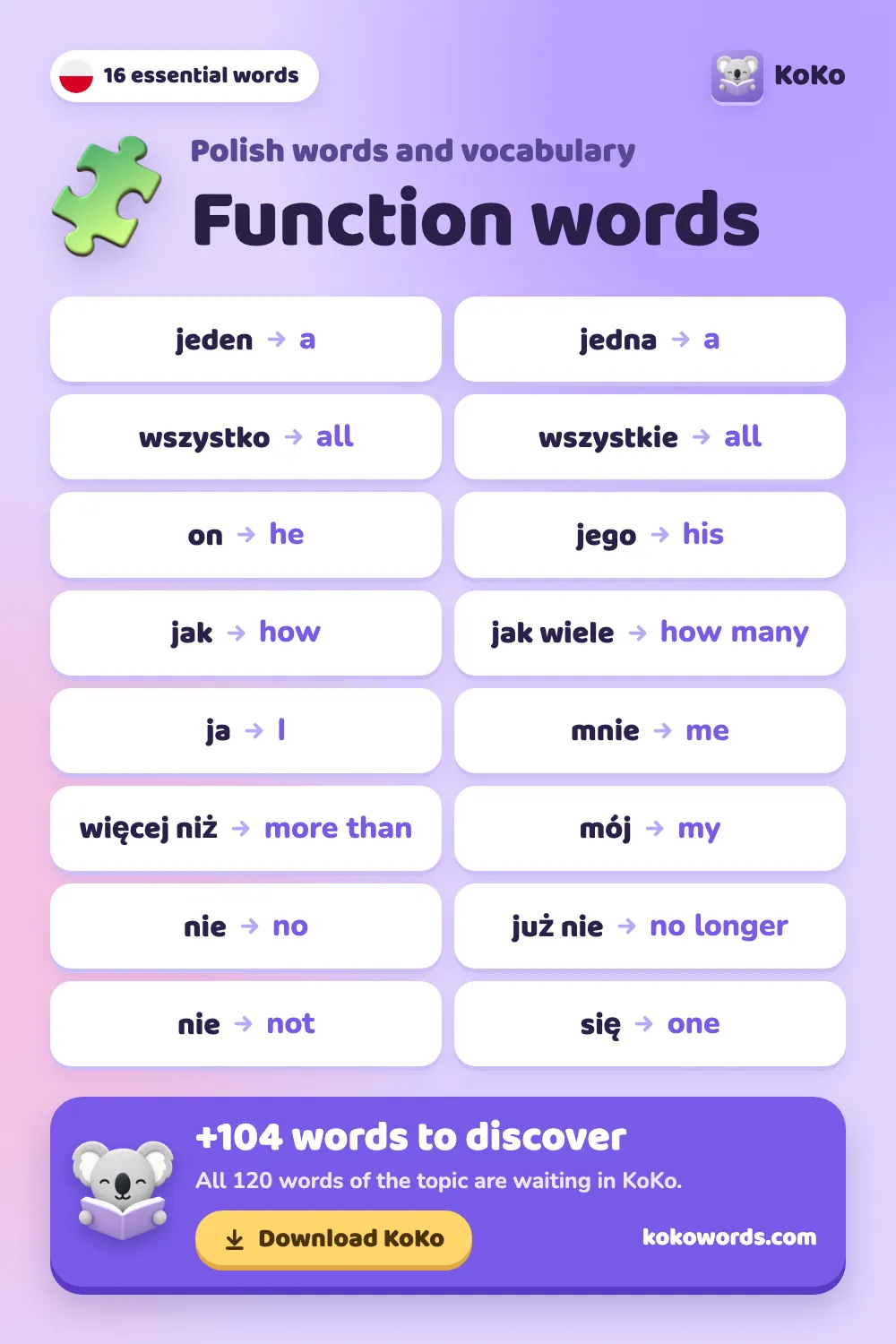
| jeden | aIndefinite article, masculine singular |
| jedna | aIndefinite article, feminine singular |
| wszystko | allDeterminer or pronoun, the whole of a set |
| wszystkie | allDeterminer, feminine plural |
| Ten kwiat jest żółty, a wszystkie inne są niebieskie.This flower is yellow, but all the others are blue. | |
| on | heSubject pronoun, masculine singular |
| On ją kocha.He loves her. | |
| jego | hisSingular possessor, belonging to him or her |
| Jego teoria jest trudna do zrozumienia.His theory is difficult to understand. | |
| jak | how |
| Jak się masz?How are you? | |
| jak wiele | how manyFollowed by a noun, to ask about a number |
| Jak wiele jest miast w Montanie?How many cities are there in Montana? | |
| ja | ISubject pronoun, first person singular |
| Gdzie ja jestem?Where am I? | |
| mnie | meStressed form, after a preposition or on its own |
| Nikt mnie nie rozumie.Nobody understands me. | |
| więcej niż | more than |
| Nie chcę wydać więcej niż 10 dolarów.I don't want to spend more than $10. | |
| mój | myPossessive determiner, before the noun |
| Mój ojciec pali.My father smokes. | |
| nie | noNegative answer |
| już nie | no longer |
| Moi rodzice już nie żyją.My parents are no longer living. | |
| nie | notNegating the verb |
| To nie jest zdanie.This is not a sentence. | |
| się | one |
| ona | sheSubject pronoun, feminine singular |
| Ona nie jest biedna.She isn't poor. | |
| trochę | somePartitive article, feminine singular |
| trochę | somePartitive article, masculine singular |
| coś | somethingIndefinite pronoun, an unspecified thing |
| Mam coś dla ciebie.I have something for you. | |
| tamto | thatDemonstrative pronoun, refers to something far away or already mentioned |
| To tamto okienko.That counter there. | |
| ta | that oneDemonstrative pronoun, feminine singular |
| ten | that oneDemonstrative pronoun, masculine singular |
| ta | theDefinite article, feminine singular |
| Czy ta droga prowadzi na dworzec? | |
| te | theDefinite article, plural |
| ich | theirPlural possessor, belonging to them |
| To ich dom.This is their house. | |
| nich | themStressed pronoun after a preposition |
| Nie lubię nikogo z nich.I like neither of them. | |
| jest | there isExistence |
| te | theseDemonstrative determiner, plural |
| Te książki są stare.These books are old. | |
| oni | theySubject pronoun |
| Oni nas nie znają.They don't know us. | |
| ten | this |
| Proszę wypełnić ten formularz.Fill out this form, please. | |
| ta | thisDemonstrative determiner, feminine singular |
| Ta działka jest moją własnością.This land is my property. | |
| ten | this |
| Ten komputer jest tak stary jak ja.This computer is as old as me. | |
| to | this oneDemonstrative pronoun, refers to something close |
| To nie jest zdanie.This is not a sentence. | |
| my | weSubject pronoun, first person plural |
| Tom wie coś, czego my nie wiemy.Tom knows something that we don't know. | |
| co | whatQuestion word, subject |
| że | whatBefore a verb |
| Mam nadzieję, że się panu spodoba.I hope you'll like it. | |
| co | whatOn its own or after a preposition |
| Nie ma za co.You're welcome. | |
| kiedy | when |
| gdzie | where |
| Gdzie jest hotel?Where is the hotel? | |
| owszem | yesYes, contradicting a negative statement |
| cię | youObject pronoun, informal address |
| Miło cię widzieć.Nice to see you. | |
| ty | youSubject, informal address |
| Ależ ty jesteś piękna!How beautiful you are! | |
| wy | youSubject, formal or plural address |
| Tom mówi po angielsku tak samo dobrze jak wy.Tom speaks English just as well as you guys. | |
Level 2: medium 38 words
| Polish | English |
|---|---|
| odrobina | a little |
| Odrobina szczęścia czasem prowadzi do niespodziewanego sukcesu.A little bit of luck sometimes leads to an unexpected success. | |
| cała | allDeterminer, feminine singular |
| Cała klasa zdała egzamin.The whole class passed the exam. | |
| każdy | eachDeterminer, before the noun |
| Każdy chłopiec ma rower.Each boy has a bike. | |
| każdy | each onePronoun, masculine singular |
| Każdy ma swój gust. | |
| dosyć | enough of |
| wszyscy | everybodyPeople in general, everyone together |
| Wszyscy to wiedzą.Everybody knows that. | |
| mu | himObject pronoun, to him or to her |
| Nie wierz mu.Don't trust him. | |
| on sam | himselfReflexive pronoun, masculine singular |
| On sam nie chciał z nią rozmawiać.He himself refused to talk to her. | |
| jego | his ownPossessive pronoun, used on its own |
| ile | how muchUsed on its own, to ask about a quantity or a price |
| Ile to kosztuje?How much is it? | |
| większość | most |
| Większość wind działa automatycznie.Most elevators operate automatically. | |
| ja sam | myself |
| Ja sam naprawię tę maszynę.I myself will repair that machine. | |
| nigdy | never |
| nikt | no oneFormal or legal register |
| Nikt mnie nie rozumie.No one understands me. | |
| nikt | nobodyEveryday use |
| Nikt mnie nie rozumie.Nobody understands me. | |
| żaden | nonePronoun, used on its own |
| żaden | not anyDeterminer, in a negative sentence |
| nic | nothingPronoun used on its own |
| Nic nie widzę.I see nothing. | |
| nic | nothingNegation used with the verb |
| tego | of it |
| Mam tego dość.I'm tired of it. | |
| siebie | oneselfReflexive pronoun, simple form |
| inny | other |
| Żaden inny chłopiec w klasie nie jest wyższy.No other boy in the class is taller. | |
| nasz | ourPossessive determiner, belonging to us |
| Nasz nauczyciel zawsze przychodzi punktualnie na zajęcia.Our teacher is always on time for class. | |
| ten sam | same |
| od kiedy | since when |
| Od kiedy mówisz po francusku?Since when do you speak French? | |
| jakieś | someIndefinite article, plural, before a noun |
| Czy w okolicy są jakieś niedźwiedzie?Are there any bears around here? | |
| ktoś | someoneIndefinite pronoun, an unspecified person |
| Ktoś ukradł mi walizkę.Somebody has stolen my suitcase. | |
| taki | such |
| Jaki ojciec, taki syn.Like father, like son. | |
| tam | thereAdverbial pronoun of place, replaces a complement |
| ci | thoseDemonstrative pronoun, masculine plural |
| te | thoseDemonstrative pronoun, feminine plural |
| za dużo | too much |
| Uważam, że ten stół zajmuje za dużo miejsca. | |
| jaki | whichInterrogative determiner, before the noun |
| Jaki kurs by pan polecił?Which course would you recommend? | |
| dlaczego | why |
| Dlaczego jesteś taki smutny?Why are you so sad? | |
| dlaczego nie | why not |
| Dlaczego nie jutro?Why not tomorrow? | |
| ciebie | youStressed form, after a preposition |
| To dla ciebie.This is for you. | |
| twój | yourInformal address |
| Tom to twój brat, prawda?Tom is your brother, isn't he? | |
| wasz | yourFormal or plural address; possessor addressed formally or in the plural |
| Wasz dom jest duży.Your house is big. | |
Level 3: hard 18 words
| Polish | English |
|---|---|
| byle jak | any which way |
| ktokolwiek | anyone |
| Zapraszam, ktokolwiek chce przyjść.I invite anyone, who wants to come. | |
| cokolwiek | anything |
| Czy Tom dzisiaj cokolwiek jadł?Has Tom eaten anything today? | |
| kiedykolwiek | anytime |
| gdziekolwiek | anywhere |
| Możesz iść gdziekolwiek chcesz.You can go anywhere you like. | |
| każda | each onePronoun, feminine singular |
| jeden drugiego | each otherMutual action between two people |
| niewiele | hardly |
| ona sama | herselfReflexive pronoun, feminine singular |
| Ona sama mu pomogła.She herself helped him. | |
| jak daleko | how far |
| Jak daleko stąd do muzeum?How far is it from here to the museum? | |
| jedni drugich | one anotherMutual action among several people |
| samego siebie | oneselfEmphatic form, stresses the subject |
| Bardzo trudno jest poznać samego siebie. | |
| my sami | ourselves |
| oni sami | themselvesReflexive pronoun, masculine plural |
| każdy kto | whoever |
| którego | whose |
| Znam miasto, którego mieszkańcy nigdy nie palili papierosów.I know of a city whose inhabitants never smoked. | |
| twój | yoursPossessive pronoun, used on its own |
| ty sam | yourself |
| Ty sam także możesz to zrobić.You yourself can do this, too. | |
Example sentences: Tatoeba (CC BY 2.0 FR)
Updated · Spotted a mistake?
Mini quiz
5 words from this page, picked at random. Find their translation.
Frequently asked questions
- How do you say “one” in Polish?
- “One” in Polish is się.
- How do you say “where” in Polish?
- “Where” in Polish is gdzie.
- How do you say “when” in Polish?
- “When” in Polish is kiedy.
- How many words are in this list?
- This page gives 100 Polish words on “Function words”. The full topic holds 120 in the KoKo app: 52 at the easy level, 46 at the medium level and 22 at the hard level.
- How can I remember this Polish vocabulary?
- By seeing each word again at longer and longer intervals, just before you forget it: that is spaced repetition. The KoKo app does it for you and tells you each day which words to review.
- Can I print this list or save it as a PDF?
- Yes. The “Print the list” button at the top of the page opens your device’s print dialog: choose to save as PDF to keep the 100 words and their translation, with nothing else around them.
- How do I pronounce these words?
- Tap the speaker next to a word: your device reads it aloud, if it has a voice for this language. In the KoKo app, every word is read aloud.
These lists come from KoKo, the app to learn Polish vocabulary on iPhone and Android.
 Simplified Chinese
 Traditional Chinese
 Hindi
 French
 Russian
 Indonesian
 Japanese
 Vietnamese
 Korean
 Italian
 Thai
 Romanian
 Hebrew
 Danish
 Norwegian